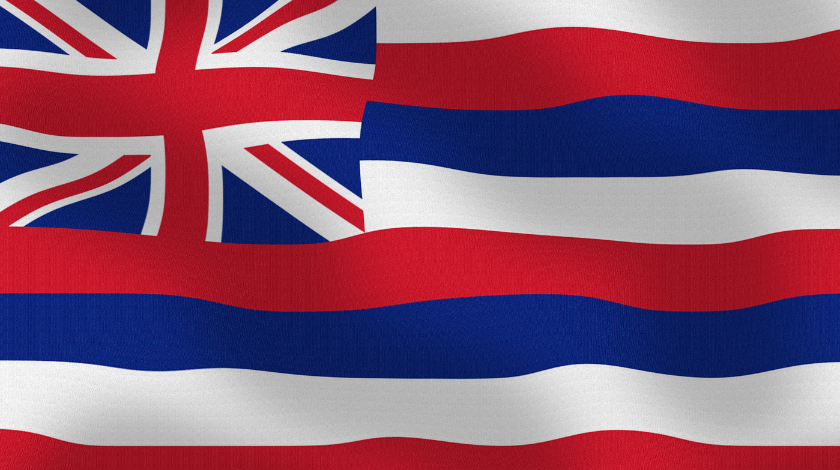
If you have ever visited the beautiful islands of Hawaii, or even if you have just looked at a map of state symbols, you might have paused when you saw the official state flag. It is one of the most confusing visuals for people who are not familiar with the history of the Pacific. You look at it and see the United States colors of red, white, and blue, but then in the top corner, there is the Union Jack, which is the flag of the United Kingdom. It makes people ask the same question over and over. Is Hawaii British? Why would an American state fly the flag of another country?
The answer to this is not short, and it is certainly not boring. The history of the Hawaii flag, or Ka Hae Hawaii, is a fascinating tale of kings, explorers, diplomacy, and the struggle to remain independent in a world where big powers were trying to take over everything. As someone who has spent time studying the history of the Pacific, I find the flag to be more than just cloth. It is a storyboard of the Hawaiian Kingdom’s relationship with the world. To understand this flag is to understand the intelligence of the Hawaiian monarchs and the complex identity of the Hawaiian people today.
The British Connection: Why is the Union Jack There?
The most striking feature of the Hawaii flag is undoubtedly the Union Jack located in the canton, which is the upper left corner. To understand this, we have to go back to the late 1700s. This was the time of King Kamehameha I, the great warrior king who united the Hawaiian islands. During his reign, Hawaii was becoming a central hub for trade in the Pacific Ocean. Ships from all over the world were stopping there to restock supplies.
One of the most frequent visitors was a British explorer named Captain George Vancouver. Vancouver and King Kamehameha formed a very strong, genuine friendship. It was a relationship built on mutual respect. Vancouver gave the King a Union Jack, specifically a Red Ensign, as a gift. King Kamehameha flew this flag at his royal residence and over his kingdom.
It is important to clarify a major misconception here. Many people assume that because the Union Jack is on the flag, Hawaii must have been a British colony, like Australia or New Zealand. This is actually false. Hawaii was never a British colony. King Kamehameha flew the British flag because he respected King George III and considered Britain a protector and a friend. He saw the British Empire as a powerful ally that could help deter other nations from messing with Hawaii. It was a strategic move by a smart King, not an act of submission.
The War of 1812 and the Need for a Hybrid
The use of the British flag worked well for a while, but eventually, global politics made things complicated. During the War of 1812, the United States and Great Britain were fighting each other. This put Hawaii in a very awkward position. When American ships came to Hawaii and saw the British flag flying, they were unhappy and considered Hawaii an enemy. When British ships arrived, they were happy, but the Americans were the problem.
Legend has it that at one point, King Kamehameha began flying an American flag to appease the US sailors. But then, British officers objected to that. The King was stuck in the middle. He needed a way to show that Hawaii was an independent, neutral nation that wanted to trade with everyone. He could not just pick one side without making enemies of the other.
This led to the creation of the distinctive Hawaii flag we see today. It was designed to be a hybrid. It kept the Union Jack in the corner to honor the long friendship with Britain. However, it added stripes across the field of the flag, which is very similar to the design of the American flag. By combining elements of both the British and American flags, the King created a symbol that allowed Hawaii to navigate the dangerous waters of international politics. It was a brilliant diplomatic compromise.
Decoding the Design: The Stripes and The Islands
While the Union Jack gets all the attention, the stripes on the Hawaii flag are just as important. If you count them, you will see there are exactly eight horizontal stripes. These are not random. Each stripe represents one of the eight major islands that make up the Hawaiian chain.
The islands represented are Hawaii (the Big Island), Maui, Oahu, Kauai, Molokai, Lanai, Niihau, and Kahoolawe. It is a beautiful way to symbolize the unity of the archipelago. Before King Kamehameha, these islands were often ruled by different chiefs who fought against each other constantly. The flag represents the unification of these islands under one sovereign rule.
The colors of the stripes are white, red, and blue. Over the years, the order of these colors has changed in various historical drawings, but eventually, it was standardized. The current order from the top down is usually white, red, blue, white, red, blue, white, red. These colors were likely chosen simply because the available flags they had to work with at the time were British and American flags, which were made of red, white, and blue cloth. However, some historians believe the colors also hold symbolic meanings of truth (white), bravery (red), and loyalty (blue), though this is a more modern interpretation.
The Kanaka Maoli Flag: A Symbol of Native Sovereignty
If you drive around Hawaii today, especially in areas with a high population of Native Hawaiians, you might see a different flag flying. It has stripes of green, red, and yellow, and in the center, there is a green shield with crossed paddles. This is known as the Kanaka Maoli flag.
This flag has become very popular in recent decades, particularly within the Hawaiian sovereignty movement. The term “Kanaka Maoli” translates roughly to “true people” or “original people” of the land. According to supporters of this flag, it was the original personal flag of King Kamehameha long before the British-influenced flag was adopted.
The symbolism here is deeply rooted in the culture. The green represents the land and the people’s love for it. The red represents the blood of the people and the ancestors. The yellow represents the spirituality and the alii, or the royalty. The shield in the middle is a pahu (drum) and the paddles represent the voyaging history of the Polynesians.
However, I should mention that there is some historical debate about this flag. Some historians argue that there is no physical evidence or written record from the 1800s that proves this flag existed back then. They suggest it might be a modern design created in the 1990s to give the sovereignty movement a symbol that is free from colonial imagery like the Union Jack.
Regardless of its historical age, the Kanaka Maoli flag is powerful. For many Hawaiians, the official state flag represents the government that overthrew their kingdom in 1893. The Kanaka Maoli flag, on the other hand, feels like a symbol that belongs purely to the people. It represents a resistance to colonization and a pride in their genealogy. Seeing it fly on the back of trucks or on front porches shows that the native identity is still very much alive and resisting erasure.
Modern Protocols and The Flag in Distress
The way the flag is treated in Hawaii carries a lot of weight. Because of the deep love for the land, or aloha aina, the flag is treated with immense respect. There is a specific holiday, July 31st, known as Ka Hae Hawaii Day, or Hawaiian Flag Day. It is a time to celebrate the history and complexity of the islands.
You might also encounter situations where you see the Hawaii flag flying upside down. In standard flag protocol used internationally and by the US military, flying a flag upside down is a signal of dire distress or extreme danger to life and property. However, in Hawaii, this act has taken on a political meaning.
During the protests regarding the construction of the Thirty Meter Telescope on Mauna Kea, the upside-down flag became a universal symbol of the movement. The protectors of the mountain, or kia’i, flew the flag upside down to signal that the Hawaiian nation is in distress. They argued that their sacred lands were being desecrated and that their culture was in danger.
When you see the flag inverted like that, it is not an act of disrespect toward the flag itself. In fact, it is the opposite. It is a cry for help and a statement that things are not right in the islands. It is a very emotional sight. I have seen lines of cars waving upside-down flags, and the feeling in the air is one of heavy seriousness and determination. It reminds you that for Native Hawaiians, the history of the overthrow is not just a chapter in a textbook. It is a lived reality that they are still dealing with today.
The Continuity of the Kingdom
One of the most unique aspects of the Hawaii flag is that it has served three different forms of government without changing. It was the flag of the independent Kingdom of Hawaii under the monarchy. After the monarchy was illegally overthrown in 1893, the provisional government and later the Republic of Hawaii kept the flag. Finally, when Hawaii was annexed and eventually became the 50th US state in 1959, the flag remained the same.
This continuity is rare. Usually, when governments change, flags change. The fact that the Hawaii flag has remained constant suggests that the identity of the islands is stronger than whatever government happens to be in power. It serves as a visual bridge connecting the modern state back to the days of King Kamehameha.
When you look at the flag, you also see the influence of the missionaries and the westernization of the islands. But if you look closer, you see the resilience of a people who adapted to survive. King Kamehameha knew he could not fight the western world with just spears; he had to fight them with diplomacy and intellect. The flag is the ultimate proof of that strategy. It said to the world, “We are part of the global community, we are civilized by your standards, but we are still Hawaii.”
Conclusion
The flag of Hawaii is a complex tapestry woven from threads of friendship, war, diplomacy, and survival. It is the only US state flag that features the flag of a foreign monarchy, and that alone makes it a curiosity. But beyond the visual oddity of the Union Jack and the stripes, it holds the soul of the islands.
It tells the story of King Kamehameha’s vision to unite the islands. It tells the story of a small island nation navigating between the superpowers of Britain and America. And today, through the presence of the Kanaka Maoli flag and the protests on Mauna Kea, the flag helps tell the continuing story of a people fighting to keep their culture alive.
So, the next time you see Ka Hae Hawaii, remember that you are looking at more than just a state symbol. You are looking at a relic of a Kingdom that still lives in the hearts of its people. It is a reminder that Hawaii is not just a tourist destination or a collection of beaches. It is a place with a deep, sometimes painful, but always proud history.
Frequently Asked Questions (FAQ)
1. Is the Hawaii flag the only US state flag with the Union Jack?
Yes, Hawaii is the only US state flag that incorporates the Union Jack. This is because of the historical friendship between the Hawaiian Kingdom and the British Empire, rather than colonial rule.
2. What do the 8 stripes on the Hawaii flag represent?
The eight horizontal stripes represent the eight major islands of Hawaii: Hawaii, Maui, Oahu, Kauai, Molokai, Lanai, Niihau, and Kahoolawe.
3. Was Hawaii a British colony?
No, Hawaii was never a British colony. King Kamehameha I placed the Union Jack on the flag as a symbol of friendship and to imply a protectorate status to deter other nations, but the Hawaiian Kingdom remained independent.
4. What is the green, red, and yellow flag seen in Hawaii?
That is the Kanaka Maoli flag. It is considered by many to be the “native” flag of the Hawaiian people. It is often used by the Hawaiian sovereignty movement and represents the native genealogy and land, distinct from the colonial history associated with the official flag.
5. Why do some people fly the Hawaii flag upside down?
Flying the flag upside down is traditionally a sign of distress. In modern Hawaii, it is often used as a form of political protest, particularly regarding issues of land rights and the protection of sacred sites like Mauna Kea. It signals that the Hawaiian nation and culture are in distress.
6. When was the current Hawaii flag adopted?
The current design has been used since the days of the Hawaiian Kingdom in 1845. It continued to be used through the Republic era and was officially adopted as the state flag in 1959 when Hawaii joined the United States.